This game aims to help you get a feel for the difficult decisions that people across the organization are making each day.
Winning looks like successfully balancing a simple set of metrics: staff retention, net votes, and revenue. If you're able to consistently maintain a positive score on those metrics – without letting tech debt overwhelm you – you'll do well!
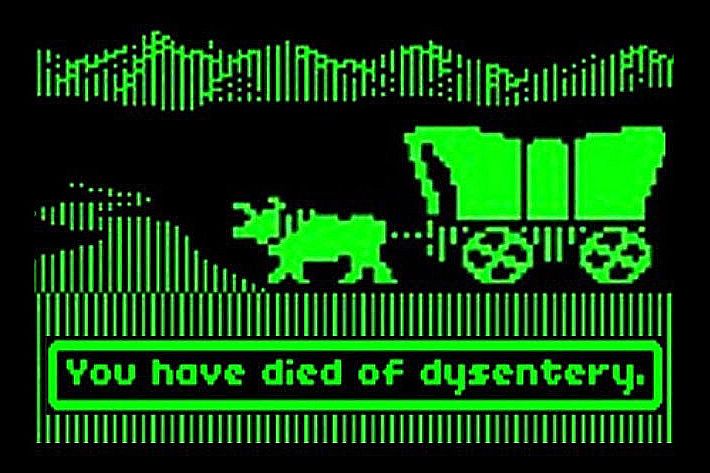
Similar to the classic 90's Oregon Trail video game, you'll be faced with difficult decisions, and your choices will affect your chance of success. Also similar to the Oregon Trail, sometimes you won't have a choice: you'll be presented with something outside your control, which you'll just have to accept.
If you're competitive: the max score of 100 looks like staying alive for 25 turns on Crazy mode – ending the game with all four metrics at 100.
Oregonizer Trail aims to make tradeoffs more real. Each person and each team juggle different incentives, different priorities, and different constraints – and each of us are primarily aware of our own (while being less viscerally aware of those of others). This can be especially true in an organization with both highly technical staff and staff who lead less technical areas like account management, comms, operations, etc. It requires a lot of empathy to navigate the cross-functional set of decisions that go into each program we run!
This is difficult to learn, because most of us are primarily-aware of one type of priority/metric (and less tuned into the others) – while many decisions ultimately come down to yes or no, on specific questions.
The key insight for successful players will be that very few of these questions have an objectively-correct answer. Instead, winning will look like intuiting the likely effect of a given choice on your metrics and making the choice whose downsides you're prepared to accept at that moment, as you try to keep your head above water. It's all situational.
You'll also notice that effects of different choices have an element of randomness (sometimes effects are larger than at other times), and as the difficulty increases, those effect sizes grow. You don’t always know how a decision is going to turn out or the effect it’s going to have.